Bedding · Materials & comfort
Wool and Latex Mattress Toppers: How to Compare Feel, Heat, and Support
A topper can soften a firm bed, add a little cushioning, or change the way warmth and moisture feel through the night. Wool and latex approach that task differently: wool offers a gently yielding, fiber-filled layer, while latex tends to feel springier and more responsive. Understanding those contrasts—and the details of thickness, construction, and care—can help you choose a layer that complements rather than obscures your mattress.
Published November 5, 2026
A small layer, a noticeable change
A mattress is not a single surface so much as a small landscape of materials. Beneath the sheet, the comfort layer meets the body first; below it, the mattress’s deeper construction carries weight and helps determine how much the sleeper sinks. Add a topper, and that landscape changes. The new layer may soften pressure at the shoulders and hips, make the surface feel more buoyant, or alter how warm and dry the bed feels.
But a topper cannot reliably repair a mattress whose support structure has sagged or broken down. It can change the sensation at the surface; it cannot restore missing support underneath. That distinction is central when comparing wool and latex. Both can add comfort, yet they do so with different textures, behavior, and care needs.
Wool is a natural fiber that forms a soft, somewhat insulating layer. Latex is an elastic material that compresses under weight and springs back, often creating a more buoyant impression. Neither is automatically cooler, more supportive, or more suitable for every sleeper. The best fit depends on the mattress, the sleeper’s preferences, the room, and the kind of change being sought.
What wool feels like on a mattress
Wool fibers have a crimped structure that can trap pockets of air. In bedding, that structure gives wool a soft, gently cushioned character and can help moderate the feel of warmth and moisture near the body. Instead of the pronounced spring-back associated with latex, wool generally compresses more quietly beneath weight. Its surface may feel plush at first, then settle as the fibers respond to repeated use.
Wool is often described as temperature regulating. That phrase is useful, but it should not be read as a promise that a wool layer will keep every person cool in every room. Wool can absorb and release moisture, and its fibers help buffer changes in the immediate sleep environment. How warm a bed feels also depends on the mattress, sheets, room temperature, humidity, sleepwear, and personal comfort. A thick insulating layer may feel cozy to one sleeper and too warm to another.
A wool topper can make a firm mattress feel gentler without creating the same close, enveloping sensation some foam layers produce. It may suit someone who wants softness and a more natural fiber surface but does not want a pronounced bounce. Since wool can compress with time, consider how the product is constructed and whether it can be refreshed, rotated, or otherwise maintained according to its maker’s instructions.
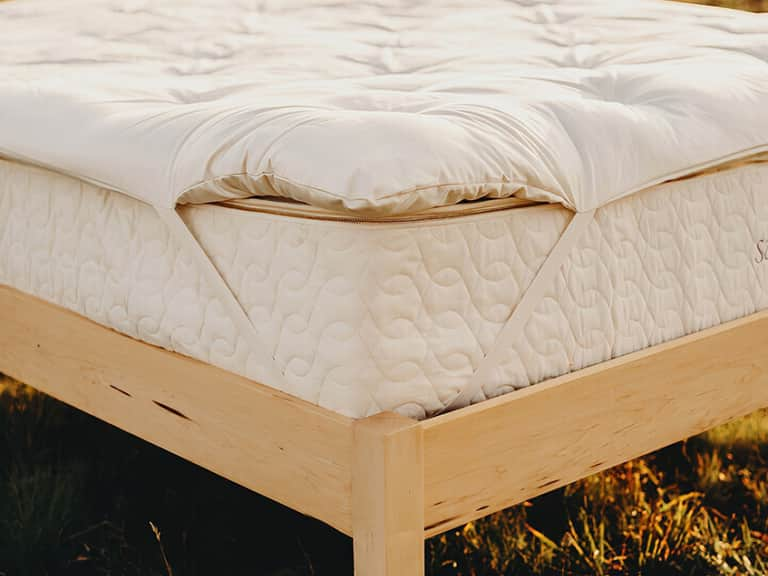
For a concrete example of this kind of bedding layer, the Savvy Rest Natural Savvy Woolsy Mattress Topper is described as having a generous wool fill in a quilted organic cotton cover, corner straps, and an approximate three-inch height. Its maker recommends placing an organic mattress pad over it to help protect the topper and mattress from stains and perspiration. Those details illustrate why a product’s construction and care guidance matter as much as the word “wool” on a label.
What latex feels like on a mattress
Latex has a distinct, elastic response. When pressure is applied, it compresses and pushes back, so sleepers may experience a floating or buoyant sensation rather than sinking slowly into the material. Depending on the formulation, firmness, shape, and thickness, latex can provide a responsive cushion that makes it easier to shift positions than a slow-recovery foam surface.
That responsiveness is not the same thing as firm support in every situation. A topper changes the feel of the upper surface, while the mattress beneath remains responsible for much of the bed’s underlying support. A soft or thick latex layer can still allow substantial compression; a firmer, thinner one may change the surface more modestly. The body’s alignment depends on the full sleep system, body shape, sleep position, and the condition of the mattress—not on material name alone.
Latex may be a sensible direction for sleepers who want noticeable cushioning with a springier feel, or who dislike the sensation of being slowly cradled. It can also feel more substantial and resilient than a light pad. However, latex products vary. Look for the type of latex, its firmness, how it is formed, its thickness, and the materials used in its cover. Natural, synthetic, and blended latex are not interchangeable descriptions, and certification claims should be checked against the specific product documentation.
Airflow and heat also depend on construction. Some latex designs include perforations or shaped channels that allow air to move through the material; others have a denser structure or a cover that affects ventilation. It is wise to evaluate the finished topper, rather than assuming that all latex sleeps cool simply because it is latex.
Wool versus latex: the practical comparison
The comparison is not a contest with one universal winner. Each material changes the mattress in a particular way. Wool leans toward soft, quiet cushioning and moisture management; latex tends toward elastic support and a more active response. The table below offers a starting point, not a substitute for product-specific specifications.
| Question | Wool topper | Latex topper |
|---|---|---|
| Typical feel | Soft, cushioned, and comparatively quiet | Buoyant, elastic, and responsive |
| How it yields | Fibers compress and gradually settle | Material compresses and springs back |
| Temperature and moisture | Can buffer moisture and warmth; insulation varies with construction | Airflow and heat depend on formulation, shape, cover, and thickness |
| Often considered by | Sleepers seeking a softer, fiber-based surface | Sleepers seeking resilient cushioning and easier movement |
| Care questions | Check whether it can be aired, rotated, or cleaned; avoid assuming it is washable | Check the maker’s cleaning rules; cores and covers may have different care needs |
These descriptions are broad. A thick, tightly quilted wool topper may feel quite different from a thinner one. Latex can range from gently cushioning to distinctly firm. Covers, quilting, attachment, and the mattress underneath all influence the result. If possible, compare detailed specifications and return terms before making a decision.
Heat, moisture, and the sleep environment
“Hot sleeping” has many causes. A room that holds heat, a heavy comforter, close-fitting sleepwear, a mattress cover that restricts airflow, or individual changes in temperature sensitivity can shape the experience as much as the topper. Before changing materials, take stock of the whole bed: what is under the sheet, how heavy the bedding is, and whether air can circulate around the sleeper.
Wool’s ability to absorb moisture without immediately feeling wet is one reason it appears in bedding. It can help manage humidity close to the surface, but it is not a ventilation system and cannot compensate for every hot or humid bedroom. Likewise, latex’s resilience does not guarantee a cool night. A dense core under a thick, close-fitting cover may feel different from an open, ventilated design.
When warmth is the main concern, read the product description for construction details, not just comfort claims. Look at the fill or core, the cover fabric, quilting, and the care instructions. Consider whether the bed already has a waterproof protector or multiple insulating layers. Removing an unnecessary layer may produce a more noticeable change than replacing a topper.
In Orange County and other regions with varied indoor conditions, bedroom comfort can shift with season, coastal influence, building design, and air conditioning habits. A topper should be considered within that local setting, but the same principle applies anywhere: room climate and bedding work together. A material alone cannot control the temperature of an entire sleep environment.
Thickness: how much change is enough?
Thickness is one of the clearest clues to how strongly a topper may alter the bed, though it is not the only one. A thinner layer typically makes a more restrained adjustment. A thicker layer may create more cushioning and a more obvious change in how the body settles. The effect also depends on firmness and density: a thick, soft topper and a thick, firm topper will not feel alike.
For wool, thickness can reflect the amount of fiber and the depth of the quilted construction. Over time, wool may compress, so the initial loft may not remain unchanged. For latex, thickness affects how far the sleeper can engage with the material before feeling the mattress below. The core’s firmness and resilience matter alongside its height.
Before choosing, ask what is wrong with the current bed. If the surface is slightly too firm, a modest comfort layer may be enough. If the mattress has a visible hollow, a topper may temporarily soften the sensation but is unlikely to correct the underlying sag. If the bed is already too soft, adding more cushioning could worsen the feeling of sinking. In that case, assess the mattress and foundation before adding another layer.
- For a subtle adjustment: look for a thinner, less plush option and check the product’s firmness or loft details.
- For more surface cushioning: compare thicker constructions, but consider whether the mattress beneath still provides adequate support.
- For an uneven or sagging bed: investigate the mattress, foundation, and warranty before treating the issue as a topper problem.
Mattress pad vs. topper: different jobs
The terms are sometimes used loosely, but a mattress pad and a topper usually serve different purposes. A pad is generally a relatively light layer intended to protect the mattress, add a small amount of softness, or both. A topper is usually thicker and designed to make a more noticeable change to the sleeping surface.
Protection is not the same as comfort. A washable pad or protector may help limit ordinary wear and exposure to perspiration or spills, depending on its materials and construction. A plush topper may improve surface feel, but it is not necessarily waterproof or easy to clean. If a topper’s care instructions do not allow washing, a separate protective layer can be important—provided it fits correctly and does not undermine the qualities you value in the topper.
Layer order matters. A common arrangement is mattress, topper, protective pad or protector if suitable, then fitted sheet. However, the manufacturer may specify a different approach. A tightly fitted sheet that is too small for the combined depth can pull at the corners or compress the layers. Measure the mattress and all added bedding, then confirm pocket depth and fit before buying sheets.
For anyone deciding between a mattress pad vs. topper, consider the purpose first. If the priority is shielding a mattress from everyday moisture, start with a protector. If the surface needs a small comfort adjustment, a pad may suffice. If a more substantial change in cushioning is desired, compare toppers—while remembering that neither option replaces a worn-out support core.
Support, sleep position, and pressure points
Sleep position can help clarify what kind of surface change to test. Side sleepers often experience greater pressure at the shoulder and hip, so they may look for enough cushioning at those points while maintaining a comfortable, neutral-feeling alignment. Back sleepers may prefer a surface that cushions without allowing the pelvis to sink excessively. Stomach sleepers can be especially sensitive to too much softness, although individual needs vary.
These are starting points, not rules. Body shape, weight distribution, mobility, and personal comfort all affect how a bed feels. The key question is not whether a material is labeled “supportive,” but whether the complete sleep surface feels comfortable and stable for the person using it. A topper that feels agreeable for a few minutes in a showroom may feel different after several nights.
Try to evaluate changes systematically. Note the current discomfort, change one bedding element at a time, and give the body a reasonable adjustment period if the product’s return policy permits. Pay attention to recurring pressure, ease of movement, and whether the bed feels supportive across the whole night. If pain is persistent or severe, a topper is not a substitute for medical advice.
Care, durability, and the fine print
Natural materials still need appropriate care. Wool products may be vulnerable to shrinkage or damage if washed or dried incorrectly; many are not designed for routine machine washing. Follow the label, and ask whether spot cleaning, airing, or professional care is recommended. A removable cover, if present, may have different care requirements from the inner fill.
Latex also demands attention to instructions. The core may need to be kept dry, protected from harsh heat, or cleaned only in a particular way. Some products have removable covers; others do not. Do not assume that a removable cover means the inner material is washable. When a spill occurs, follow the specific manufacturer guidance rather than applying a general internet tip that could damage the layer.
Durability depends on materials, construction, use, and maintenance. Regularly inspect for uneven compression, shifting, odor, or changes in feel. If the design allows it, rotating the topper may distribute wear, but not every product is intended to be rotated or flipped. Keep warranty terms and exclusions available, especially if a change in loft or shape appears unusually rapid.
Certifications can help clarify specific claims, but they do not mean that every person will find a product comfortable or that it will last a fixed number of years. Check what the certification applies to—the fiber, material, processing, or finished item—and consult current documentation. Avoid relying on vague terms such as “natural” or “eco-friendly” without learning what the product actually contains.
A practical checklist before choosing
Before comparing wool and latex toppers, take a few measurements and identify the change you want. A clear checklist can prevent a material preference from distracting from more important questions about fit, support, and maintenance.
- Inspect the mattress: note its age, firmness, visible sagging, and condition of the foundation.
- Name the goal: are you seeking softer pressure relief, a bouncier surface, moisture management, or mattress protection?
- Compare construction: check thickness, fill or core, firmness, cover, attachment, and whether the layer can shift.
- Review care: find out what can be washed, how spills should be handled, and whether airing or rotation is allowed.
- Check fit: measure mattress dimensions and depth, including the planned topper and protector, before buying fitted sheets.
- Read return and warranty terms: understand trial periods, shipping responsibilities, and exclusions before opening or using the item.
The lasting difference is in the feel
Wool and latex are not interchangeable ways to make a bed softer. Wool usually brings a quieter, fiber-based cushion with moisture-managing qualities and a gently insulating character. Latex typically offers a more resilient, springy surface that responds quickly to movement. The right choice depends less on broad promises than on how those qualities meet the mattress already in the room.
Start with the actual problem: a surface that feels too firm, a desire for a livelier response, or a need for a protective layer. Then compare thickness, construction, fit, and care. A topper can be a useful adjustment when the mattress beneath remains sound. Chosen thoughtfully, it changes the first point of contact between body and bed without asking a single material to solve every challenge of sleep.
Frequently asked questions
Is a wool or latex mattress topper better for heat?
Neither is universally cooler. Wool can help manage moisture and buffer temperature near the surface, while latex’s airflow depends on its formulation, shape, cover, and thickness. Room conditions and the rest of the bedding also matter. Compare the finished construction and consider the entire sleep setup.
Does a latex topper make a mattress more supportive?
It can change the surface’s cushioning and response, but it does not repair a sagging or failing mattress. Support comes from the full sleep system, including the underlying mattress and foundation. If the bed has a noticeable hollow, investigate that structure before relying on a topper.
Can a wool topper be washed?
Care varies by product. Some wool toppers are not designed for machine washing, and incorrect washing or drying can damage or shrink the material. Read the care label and follow the maker’s instructions for cleaning, airing, and stain treatment.
What is the difference between a mattress pad and a topper?
A mattress pad is generally a lighter layer for modest comfort or protection. A topper is usually thicker and intended to produce a more noticeable change in the feel of the bed. Product labels are not always consistent, so compare dimensions, materials, and construction rather than relying on the name alone.
Should a mattress protector go over a topper?
That can help protect both layers, but the right arrangement depends on their instructions and materials. Choose a protector that fits the combined depth and does not compromise the comfort you want. Always check whether the topper maker recommends a particular layer order.